
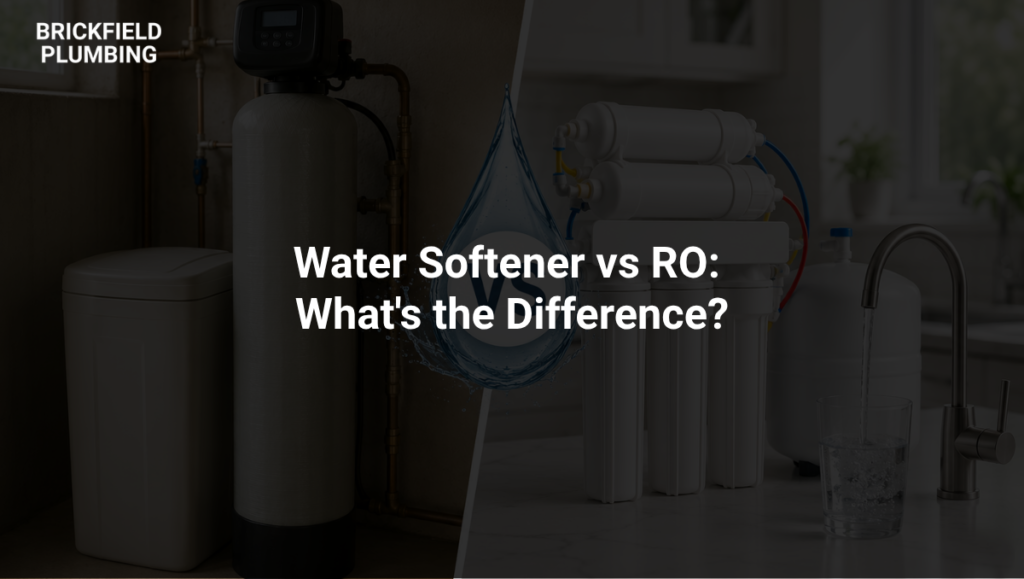
Water softener vs RO: Learn how each system works, what they remove and which option may be right for your home.
Water Softener vs RO: What’s the Difference?
Water softeners and reverse osmosis systems are both used for residential water treatment, but they solve different problems.
If you’re researching water treatment for your Kitchener home, understanding the difference can help you choose the right system for your needs.
A water softener primarily addresses hardness minerals, such as calcium and magnesium.
Reverse osmosis, often called RO, uses a semi-permeable membrane to reduce certain dissolved substances from water.
In some homes, the two systems can even be used together.
If you’re unfamiliar with hard water in the area, our guide to hard water in Kitchener explains why it is common and what homeowners should know.
What Does a Water Softener Do?
A traditional water softener uses ion exchange to reduce hardness minerals such as calcium and magnesium.
The result is softer water throughout the portion of the home connected to the system.
A water softener is primarily intended to address:
- Hard water
- Mineral deposits
- Scale
- Hardness-related issues
This makes water softeners particularly relevant in areas such as Kitchener and Waterloo Region, where hard water is common.
A softener is generally a whole-home water treatment system, although the exact configuration depends on the home’s plumbing and the system selected.
What Does Reverse Osmosis Do?
Reverse osmosis uses a semi-permeable membrane to reduce certain dissolved substances from water.
Unlike a conventional water softener, an RO system is commonly installed as a point-of-use treatment system, such as under a kitchen sink, rather than treating all of the water entering the home.
The substances an RO system reduces depend on the specific system, membrane and certification. Homeowners should therefore review the manufacturer’s performance information before choosing an RO system for a particular water-quality concern.
For more information about residential drinking-water treatment, including reverse osmosis systems and treatment-device certification, see Health Canada’s guidance on drinking water treatment.
Water Softener vs. RO: Quick Comparison
Water Softener | Reverse Osmosis | |
Primary purpose | Reduce water hardness | Reduce specific dissolved substances |
Main target | Calcium and magnesium | Depends on the system and membrane |
Typical application | Whole-home | Usually point-of-use |
Addresses hard water | Yes | Not primarily |
Reduces hardness-related scale | Yes | Not its primary purpose |
Drinking-water application | Can treat household water | Commonly used for drinking water |
Treatment method | Ion exchange | Membrane filtration |
The biggest difference is the problem each system is designed to address.
A water softener focuses on hardness. Reverse osmosis focuses on reducing specific dissolved substances.
Water Softener vs RO: Which Water Treatment System Does Your Home Need?
It depends on the problem you’re trying to solve.
Water Softener for Hard Water
A water softener may be the more appropriate option.
For example, if you’re experiencing:
- White deposits
- Spotting on glassware
- Scale around fixtures
- Hard-water residue
you may be looking for hardness reduction.
If you’re considering softening because of these issues, our guide to the benefits of a water softener explains what homeowners can realistically expect from a softening system.
Reverse Osmosis for Drinking Water
A reverse osmosis system may be worth considering depending on what you’re trying to remove.
The first step is understanding the specific water-quality concern. Testing or reviewing available water-quality information can help you determine whether additional treatment is necessary and which technology is appropriate.
An RO system shouldn’t be selected simply because it is considered a more advanced form of filtration. Different treatment technologies are designed for different purposes.
Can Reverse Osmosis Remove Hardness?
Reverse osmosis can reduce certain dissolved minerals, but it isn’t generally used as a whole-home solution for hard water.
RO systems are commonly installed at a specific drinking-water point, while a water softener is designed to address hardness throughout the home’s water supply.
If your primary concerns are scale, spotting and other effects of hard water, a water softener is generally the more appropriate treatment to investigate.
Can You Have a Water Softener and Reverse Osmosis?
Yes.
In some homes, the systems can serve complementary purposes.
A typical setup might use:
Water softener → whole-home hardness management
and
Reverse osmosis → point-of-use drinking-water treatment
The softener addresses hardness throughout the home’s water supply, while RO provides additional treatment at a specific drinking-water location.
Whether you need both depends on your water-quality concerns and treatment goals.
What About Water Filters?
A standard water filter is another category of treatment altogether.
Different filters are designed to address different substances, and their performance depends on the type of filter and its certification.
Don’t assume that a filter, water softener and RO system all perform the same function.
The right choice depends on what you’re actually trying to treat.
What About Kitchener’s Water?
Hard water is common throughout Waterloo Region.
Much of the region’s municipal water supply comes from groundwater, which naturally picks up minerals as it moves through soil and rock.
This means local homeowners may notice effects associated with water hardness, such as mineral deposits and scale.
For Kitchener homeowners whose primary concern is hard water, a water softener is generally more directly suited to the problem than using reverse osmosis to treat the entire home’s water.
However, local water conditions and individual household needs can vary, so the right treatment should be based on the specific issue you’re trying to address.
Water Softener vs RO: Which System Is Right for You?
A simple way to think about the difference is:
Choose a water softener if your primary concern is:
Hardness, mineral deposits, spotting or scale.
Consider reverse osmosis if your primary concern is:
Reducing specific dissolved substances in drinking water.
Consider both if:
You want whole-home hardness management along with additional point-of-use drinking-water treatment.
The goal isn’t to choose the most sophisticated system. It’s to choose the treatment that addresses the problem you actually have.
Final Thoughts
The easiest way to remember the difference is:
Water softener = hardness
Reverse osmosis = filtration
Neither system is automatically better.
They simply serve different purposes.
If you’re unsure which option is appropriate for your Kitchener home, a qualified plumbing or water-treatment professional can help you understand your options and determine whether additional treatment is necessary.
For homeowners considering water softener installation in Kitchener, start by learning about your home’s water hardness and the type of treatment you actually need.